Ashik Chowdhury: “We have to get it right this time”
In the second instalment of our Lunch in a Nutshell interview series, the Invest Bangladesh chairman discusses his unexpected move into public service, Bangladesh’s investment challenges and his hopes for a renewable-energy revolution.
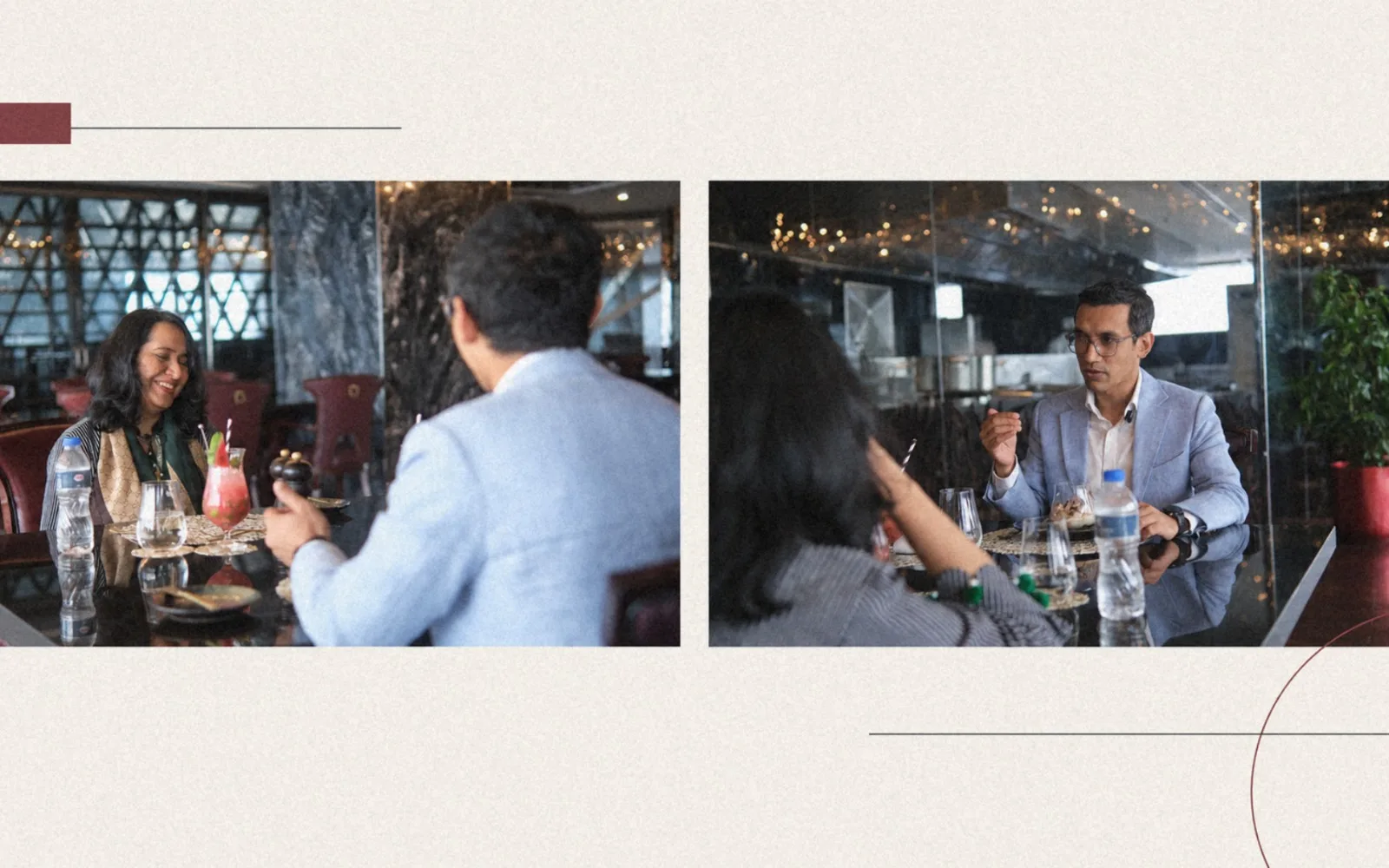
After some fifteen years of waiting on political VIPs to turn up before the show finally gets on the road, there’s something refreshing about watching one arrive exactly when he said he would. While messages from his APS had been politely giving us a heads up about a prior meeting running over, Ashik Chowdhury, the Chairman of Invest Bangladesh (formerly BIDA) pulls up into the driveway of the Renaissance Dhaka Gulshan Hotel, not a minute later than what was originally agreed on. The doors fly open and the man walks in, and for a split second, I am transported back to 2025, when he got onstage for the Bangladesh Investment Summit and made the whole nation sit up and take notice. As we smile and shake hands, his general demeanor, devoid of a single shred of self-importance, instantly bursts that bubble, and suddenly, we are just two people (and our team) heading to the 13th floor to grab a lunch together.
The welcome drink
We step into the lush interiors of the Sear Restaurant, and after settling us at our table, our hosts greet us with sparkling watermelon mojitos. It is a Saturday in the middle of an unseasonably warm September, two days before Ashik is to fly out for the UN General Assembly, and incidentally, two days after his birthday. We clink glasses and get right down to it.
To begin with, we trace his journey from a banking professional in Bangladesh, to a grad student in the UK, to a family man working in the private sector in Singapore, this last part being what he describes as ‘the most stable chapter in our lives’. Perhaps, he muses, if July 2024 had not happened, he might have happily settled in Singapore. The fateful call from the Chief Advisor that changed his life overnight has been well documented, so I focus instead on how he felt in that moment. He tells me he had always planned to go into public service at some point, “to give back to the country”, but had imagined this would probably happen after retirement. Then the July revolt happened, sending ripples of shock through the diaspora. “You have to understand, there are hundreds, thousands like me – better than me – [expats] who want to come back and try and do something for their country. It was incredibly humbling to be the one that received the call. It felt like the Universe was pushing me into the next chapter, so for me, and [my wife] Nabila, there was no question. We were on board immediately. The panic, the worry, the logistics and the second-guessing would come later, after I’d already signed the papers.”
You have to understand, there are hundreds, thousands like me – better than me – [expats] who want to come back and try and do something for their country.
The starter
At this point, the servers arrive with our salads: a colourful arrangement of roasted beetroot, crunchy Granny Smith apple, crispy fresh greens and micro greens, toasted seeds, and juicy orange segments, all sitting on a tangy orange vinaigrette, topped off by generous portions of fresh burrata. By now, I think I have a better handle on Senior Sous Chef Towhidul Islam’s style, and know that he favours visuals over flavour in his plating. It will take a little dance of the cutlery to mix up the vegetable elements with the vinaigrette at the bottom before it tastes like something, but my first bite leaves an explosion of texture in my mouth as the burrata does its thing. For an awkward few seconds, my mind goes perfectly blank as I try to process the mouthfeel. My guest seems perfectly unbothered as he tucks into his salad, so he’s clearly doing better than me.
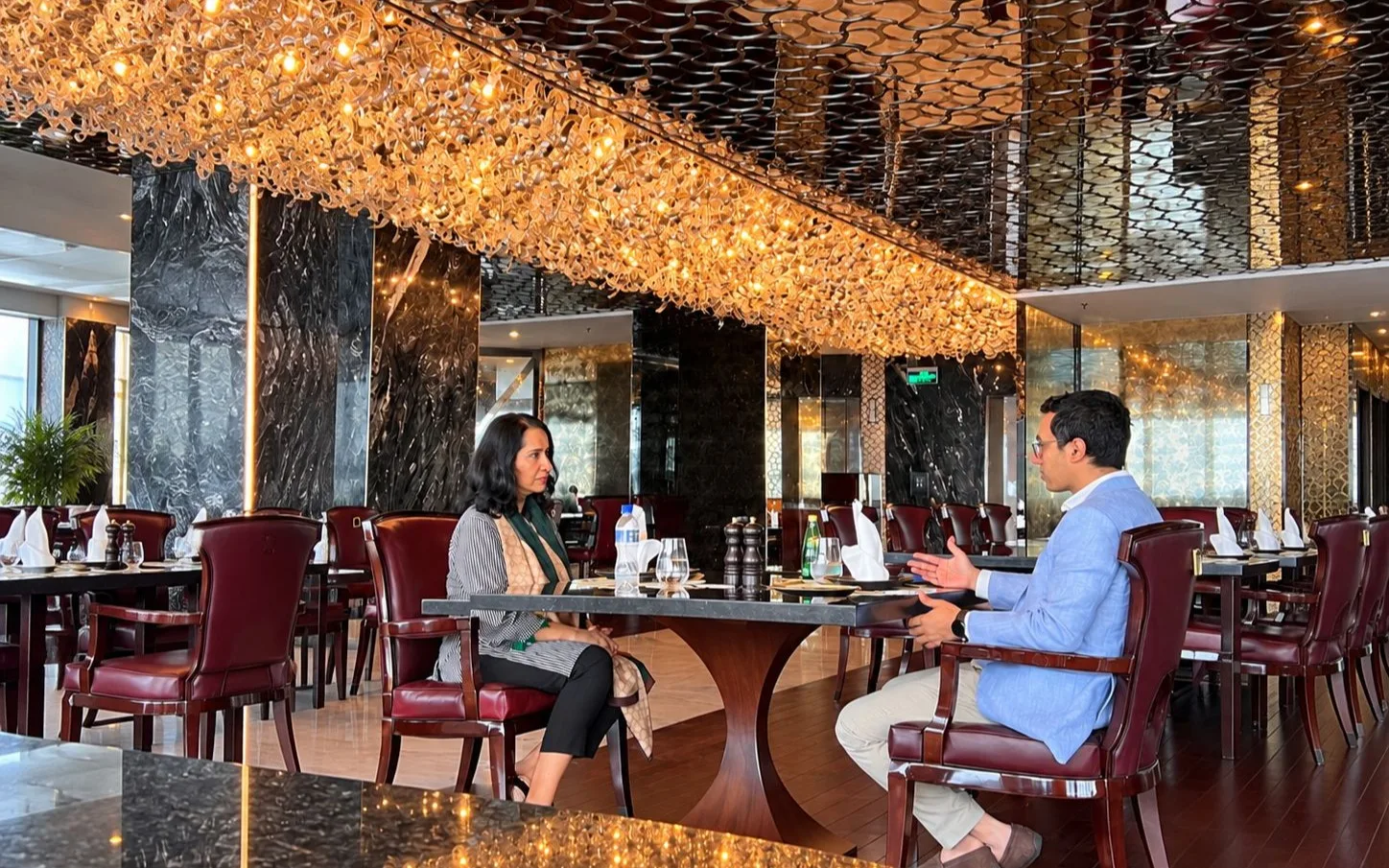
When the fog clears, I ask him what it was like for him to take the reins of BIDA (now Invest Bangladesh) as the first person from the private/corporate to hold the position. He chews thoughtfully before answering “I think it was a massive shock to the existing system, and a bold move on the Chief Advisor’s part to take this decision.”
He explains that classic government officials are groomed in a certain environment, and are highly skilled at certain aspects of the job, but may not have had the tools for what an institution like Invest Bangladesh requires. “When a bureaucrat is suddenly appointed as the BIDA chairman, he’s never spoken to an investor before, never been in an environment where such deals are done. Instead, to bring someone in who has been on that investor journey, makes more sense. So I genuinely hope that when I move out, the country continues to bring in people from our diaspora, with a similar, or even better profile than mine, but at least someone with experience in investments.”
The main course
The servers bring in our main course, Asado-style beef short ribs, served with kashundi mashed potatoes, garnished with caramelised onions, carrots and micro greens. The meat is succulent, and that bright, sharp hit of the kashundi that comes with the first bite of the potatoes is as familiar as it is exotic, while the veggies provide a savoury comfort. It’s a party in the mouth and it prompts me to switch gears and ask about planes and jumping. My guest's eyes light up, and for the next few minutes, he is just Ashik Chowdhury again, talking about his pilot training in the UK, his first jump, falling in love with the sport, and eventually bagging the world record. He achieved this in May 2024, a scant few months before the trajectory of Bangladesh was to be altered forever.
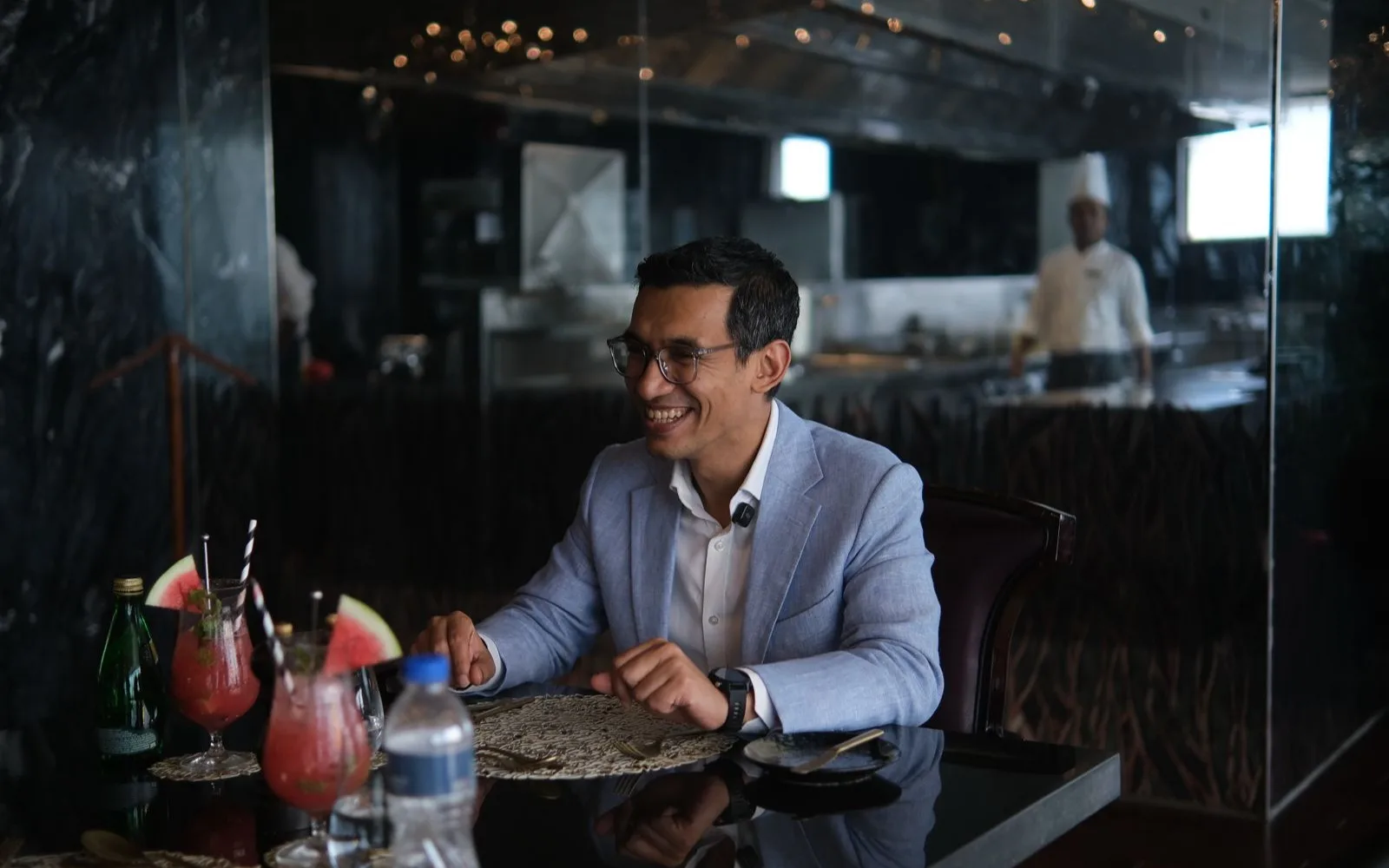
I segue back into the job at hand by asking him if this propensity for risk-taking has served him well in his public service role. He jokes by saying that choosing politics required a greater leap of faith and was more terrifying and unpredictable. When I press on about how external factors like global conflict have affected the investment promises his agency had promised a year ago. “I guess, if I may refer to Obama’s The Audacity of Hope, and say that we have constantly under-delivered relative to our potential, that has not changed. Definitely the war in Hormuz has slowed down a lot of the things that we were trying to pull off earlier, and now we are having to navigate this challenge while we push through our own agenda. The positive side to this problem, I would like to say is that it has brought to the forefront an issue that we have struggled with for years, which is the lack of energy infrastructure.” With the need for energy sovereignty now front and centre of every issue, it is, in Ashik’s opinion, finally getting the attention it deserves, although he cautions that the necessary infrastructural overhaul will not happen overnight. “As a nation, we are very good at talking about things, less so at getting things done” he concedes, but assures that this administration is actually throwing everything they can behind the push for renewable energy.
Amuse-bouche
A palate cleanser arrives in the form of a refreshing mint-infused mango sorbet that has me so excited that I pick up the wrong spoon to eat it. We glance at the skyline through the window, at the visible haze, and the conversation goes from renewables to pollution. As a father, Ashik worries about the ramifications of having moved his children from a city with a healthy AQI to a city that is consistently making headlines for topping the other end of the spectrum. He references reports about brick kilns and vehicular pollution being leading causes, and I venture the opinion that solving the traffic issue it should literally improve the climate in terms of health and also for investments. Somehow, we get to talking about the ‘Dhaka Teslas’ and how the lack of regulation for the same is putting a huge strain on our power grids.
“Typically, you see the demands for electricity increase at the GDP growth rate. Between 2025-26, however, electricity demands jumped to 17% - entirely driven by ‘Teslas’!” he exclaims.
We go from pollution to the literacy crisis, and the complexity of a government struggling to plug holes in a system that needs a complete overhaul. So in the face of these challenges, what gets Ashik Chowdhury out of bed in the morning?
“I think we truly have a generational opportunity here. It’s scary because the demographic dividend we’ve got will disappear in the next ten years. So if we don’t get it right this time, then we’re done for decades, maybe even centuries."
“I think we truly have a generational opportunity here. It’s scary because the demographic dividend we’ve got will disappear in the next ten years. So if we don’t get it right this time, then we’re done for decades, maybe even centuries. From this point of view there’s a lot on our shoulders. We have to get it right.” How is that a good thing, I ask. He tells me it’s more exciting for him to be in the thick of things in a country in its transformative state, as opposed to being in a more ‘stable’ economy with a deeply entrenched status quo. “My palette [in terms of what my team can achieve] is so diverse, and my canvas is empty.”
Dessert
Our final treat of the day is a Rashmalai tiramisu jar, which is exactly what it sounds like, and I have one last question for our esteemed guest: his hopes for UNGA. He expresses his happiness at the lineup that is representing Bangladesh at the General Assembly this year. “We have meetings lined up with larger institutions like the World Bank, and other investors. We are hoping that the message comes through clearly that we are open for business, and this is a different Bangladesh than what they have been used to.”
He agrees with my assessment that Bangladesh has a branding problem, and says the government is taking this issue into consideration. I sneak in a last-last question about what he is looking forward to in general, and without skipping a beat, he answers “What I am looking forward to, or hoping for, is a general revolution in renewables. It is my singular goal.”
"What I am looking forward to, or hoping for, is a general revolution in renewables. It is my singular goal."
Closing on that ‘sunny’ note, we call it a day and wrap up lunch. As we walk down to the exit, Ashik thanks us for the meal and makes one last attempt to convince me to someday try out skydiving. I see him off with a smile and thanks. I make no promises.
Special thanks to Sear Restaurant, Renaissance Dhaka Gulshan Hotel, the official Food and Beverage Partner of Lunch in a Nutshell.