The Leaders Started It and The Crowd Took Over
The difference between authorship and control
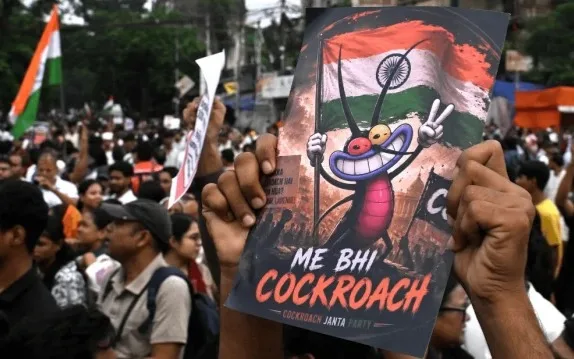
Every movement that survives its own founding moment ends up making the same claim: it never had a leader, so there was no one to buy off, no table to co-opt, no single head whose removal would kill the body. Delhi's Cockroach Janta Party spent seven weeks testing that claim against the Indian state, and the record it left behind is sharper than the slogan. The real question was never whether the CJP was leaderless. It is whether it started that way or became that way under pressure, and Bangladesh's July 2024 uprising is the clearest place to watch that difference unfold. Call it the gap between authorship and control: a movement can have someone who starts it, and still lose entirely anyone who can speak for it once it grows past the size that person can steer.
The CJP began in May as an online joke, after the chief justice of India described a group of unemployed young people turned journalists and activists as "cockroaches," a remark he later said was aimed only at holders of fake degrees. It was never a party in any formal sense, just a satirical movement built around an AI-generated mascot. But Abhijeet Dipke, a political communications strategist and former Boston University student, turned the insult into a following of millions almost overnight, a rise chronicled from the start. It found its cause when the NEET medical entrance exam was cancelled over a leaked paper, and it found a moral centre on 28 June, when the educationist Sonam Wangchuk joined with an indefinite hunger strike alongside six students from the All India Students Association, demanding Education Minister Dharmendra Pradhan's resignation, compensation for students who had died by suicide after the exam's cancellation, and accountability for the police response to demonstrators, according to a detailed timeline of the protests. When the government finally agreed to talk, it had someone to talk to: CJP spokespeople Saurav Das and Ashutosh Ranka met Union Minister J.P. Nadda on 21 July and handed over a written list of demands, a meeting both sides confirmed took place. None of that describes a movement without a head. It describes a movement with an unusually informal one, which is authorship, not leaderlessness, and the distinction carries the whole argument.
Where control actually broke down is later, on the ground, after 20 July. Pradhan never opened talks. Police carried Wangchuk to hospital on 18 July, and he kept fasting for another week from his bed. A march on Parliament that day met a citywide gathering ban and an internet shutdown that unfolded in real time, and left more than 170 people injured; Congress leaders Rahul and Priyanka Gandhi were themselves detained days later, in a crackdown described as raising serious human rights concerns. Traders around Connaught Place, a mile away, were ordered to shut their shops by evening as the crowd swelled well past anything Dipke or Wangchuk was directing, a scramble captured as it happened. Commentary written in the crackdown's immediate aftermath argued the movement had genuinely slipped its founders' grip: neither man was visible during the march itself, and public anger by then seemed to carry its own momentum, largely indifferent to who had started it,an assessment of how the movement changed shape. That is a narrower claim than saying the CJP was leaderless from day one, and a far more useful one. It names the exact moment, and the exact kind of state pressure, that turns authorship into something closer to a crowd answering to itself.
A movement without a chain of command is harder for a government to decapitate, and harder for any single politician to hijack for personal gain, as Bangladesh's own uprising proved. But that same absence cuts both ways: no one can end the movement on its own terms, and no one can be held fully accountable once it becomes something its organisers never intended. Bangladesh is still living that half of the lesson, in unresolved arguments over who led July and who answers for what came after. Delhi produced an early version of the same strain in miniature: a CJP spokesperson was sacked after being photographed at a fast-food outlet while other protesters faced tear gas, a movement built on moral authority discovering it would be judged by its own standard. Dipke insists the CJP is nothing like the movements that toppled governments in Bangladesh and Nepal, that it wants accountability rather than regime change, and that it will stay inside India's constitutional framework.The resemblance may run deeper than he would like, though, for a structural reason rather than an ideological one: authorship cannot bind the future, only describe present intentions. Whether Delhi's protest stayed disciplined or drifted was never something its founder could guarantee alone.
The state's response is a second strand of evidence, and a telling one. Delhi Police invoked a gathering ban across an entire district, shut five metro stations, and cut mobile internet in the protest area. The shutdown broke the Supreme Court's own safeguards, since no order was ever made public, and signal jammers were reported at the site as well. Bangladeshis need no reminding of what a blackout during a student-led protest looks like from the inside, or how quickly "restoring order" becomes the vocabulary of suppression. What should trouble observers is not that these tactics exist, but that India, the region's largest democracy, reached for them as readily as smaller, more fragile states have. There was no single office left to receive an ultimatum over the shutdown, so a state facing a movement with no one clearly in control could only escalate or wait it out. Here, it chose to escalate.
Deniable violence is a third strand, and it is where the two countries' patterns line up most closely. Footage from the Jantar Mantar crackdown showed a man later identified as Honey Singh Dagar beating protesters with a stick; the student body AISA has demanded the Delhi Police Commissioner's removal, alleging police and RAF personnel were deployed without identification. That allegation has not been independently established, but the nearer precedent gives it weight: Delhi's own 2020 attack on JNU, where a masked mob beat students and teachers with rods, and police eventually named a Daulat Ram College student and ABVP member, Komal Sharma, in a case that, six years on, has produced no conviction. Bangladesh knows a version of this formula: in 2018, activists from the government-affiliated student wing attacked demonstrators at Dhaka University and beyond, acting in effect as a deniable auxiliary to state security agencies while accountability went nowhere. In July 2024 the same script returned at far greater scale, when helmeted men attacked quota protesters on the Dhaka University campus and the party's general secretary effectively endorsed the violence days before the protests spiralled into the uprising that ended the government. The mechanism, not the resemblance, is what matters here. Deniable violence works only as long as no one can be reliably named, and a movement with no one clearly in control is often the least equipped to build that evidentiary record quickly.
Media framing closes the pattern. Domestic front pages largely led with the police's account of stones and lathi-charges, giving little space to the testimony of the injured, a framing pattern borne out by front-page surveys, one that Bangladeshi reporters who covered 2018 and 2024 will recognise. There is no press office in a movement like this to correct the record in real time. That absence is not incidental to the structure. It is close to definitional.
Neither mobilisation emerged in isolation. India spent the summer absorbing separate protests over land, forest and infrastructure disputes: tribal encampments in Madhya Pradesh resisting the Ken-Betwa river-link project were forcibly cleared, farmers in Gujarat drove tractor rallies against land acquisition for power corridors,students in Kerala were met with water cannon while marching over the same NEET paper leak that drove Delhi's crowds, and Jharkhand's JPSC-JSSC aspirants in Ranchi, four weeks into an agitation over alleged recruitment irregularities, produced hunger strikers hospitalised and effigies of the chief minister burned in all twenty-four districts, close enough to Delhi's protest that some of the same faces moved between both. These differed in leadership, objectives and scale, with little evidence of a coordinated campaign linking them, but together they point to a broader climate: decentralised, issue-based mobilisation increasingly filling the space where party structures used to organise dissent. The pattern was still visible in Bihar in August, when police used water cannon and detained dozens of BPSC job aspirants attempting to march on the governor's residence over allegations of leaked examination papers and other irregularities. More than 300,000 candidates had reportedly competed for just 2,000 posts, turning an examination dispute into another expression of a much larger anxiety over merit, employment and institutional fairness. Bangladesh's own uprising unfolded in a similarly layered environment. Through June and July 2024, public university teachers were waging separate nationwide protests over the discriminatory Prottoy pension scheme, while other sectors voiced grievances unconnected to the quota protests but part of a wider discontent often forgotten when July is remembered solely as student politics.
Bangladesh's July fits this same pattern of authorship giving way to lost control better than it fits the myth built around it. Students Against Discrimination gave the quota-reform movement a name, a set of demands, and, in figures such as Nahid Islam, faces reporters could quote. Identifiable coordinators existed from its earliest weeks, and several went on to hold interim government roles once the dust settled. What genuinely had no one in control was the country-wide uprising that followed the crackdown in late July, when campuses and neighbourhoods no coordinator had briefed kept the protest alive on their own initiative. Delhi and Dhaka are not proving the same claim about how protests begin. They are proving the same claim about how they escalate: that state violence against a movement with a recognisable face tends to produce a second movement with none.
None of this means Delhi is fated to repeat Bangladesh's exact trajectory. The CJP kept its stated commitment to constitutional methods throughout, and Dipke's decision not to lead another march on Parliament, weighing the human cost, showed a restraint Bangladesh's own leadership did not always manage. Congress, the Trinamool Congress and Shiv Sena (UBT) moved decisively behind the protesters, giving the movement an institutional cover that Bangladesh's uprising, by design, never had. India's federal structure, organised opposition and more entrenched judiciary are different load-bearing walls, not incidental details. Any comparison that treats Delhi 2026 as Bangladesh 2024 with different names is not reading either case carefully.
The uncomfortable truth is that the quality which makes a movement almost impossible to buy off is the same quality that makes it almost impossible to steer, and that trade-off produced its first answer within seven weeks. Pradhan resigned, the government promised fast-track courts and a new law against paper leaks, and the CJP declared victory and stood down. Read one way, that is the vindication such a movement is supposed to be incapable of winning. Read the other way, it is the argument's next data point. Two of the CJP's demands, compensation for the students who died and accountability for the police who beat marchers on 20 July, were promised, not delivered, and Dipke said as much the moment the celebrations began. Ten days on, that gap was already showing: Dipke told reporters in early August that not one family had received the promised compensation, and warned the CJP would return to the streets if the government kept stalling. Authorship gives a movement someone to negotiate with, and someone who can be held to an agreement once a government caves. The loss of control that Delhi's protest showed for a few days after 20 July leaves no one to hold anything to once the crowd that forced the concessions disperses.
Bangladesh had its version of this moment too: a government that fell within weeks, met by celebration that assumed the hardest part was over. What followed was more than a year spent arguing over who actually led July and who owes what to whom now that the crowd has gone home. That is the part no movement without a centre of control can arrange for itself: a way to make the promises made in victory outlast the moment of winning. The gap does not close when a minister resigns. It simply moves to whoever is left standing once the cameras leave.
Nafew Sajed Joy is a Bangladeshi researcher, writer, and environmentalist with a keen interest in sustainability, development, and South Asian affairs.
Disclaimer : The views and opinions expressed by contributors, authors, guests, or users are their own and do not necessarily reflect the official policy, position, or opinions of Tyger Media.