The boats that rocked Bangladesh
State-controlled rebellion isn't a rebellion at all. The stimulating, and symbolic nature of an upheaval loses its wild and imaginative charm when a government regulates culture. It kills the raw energy, edge, and spirit of a generation and its cry for freedom.
Reading
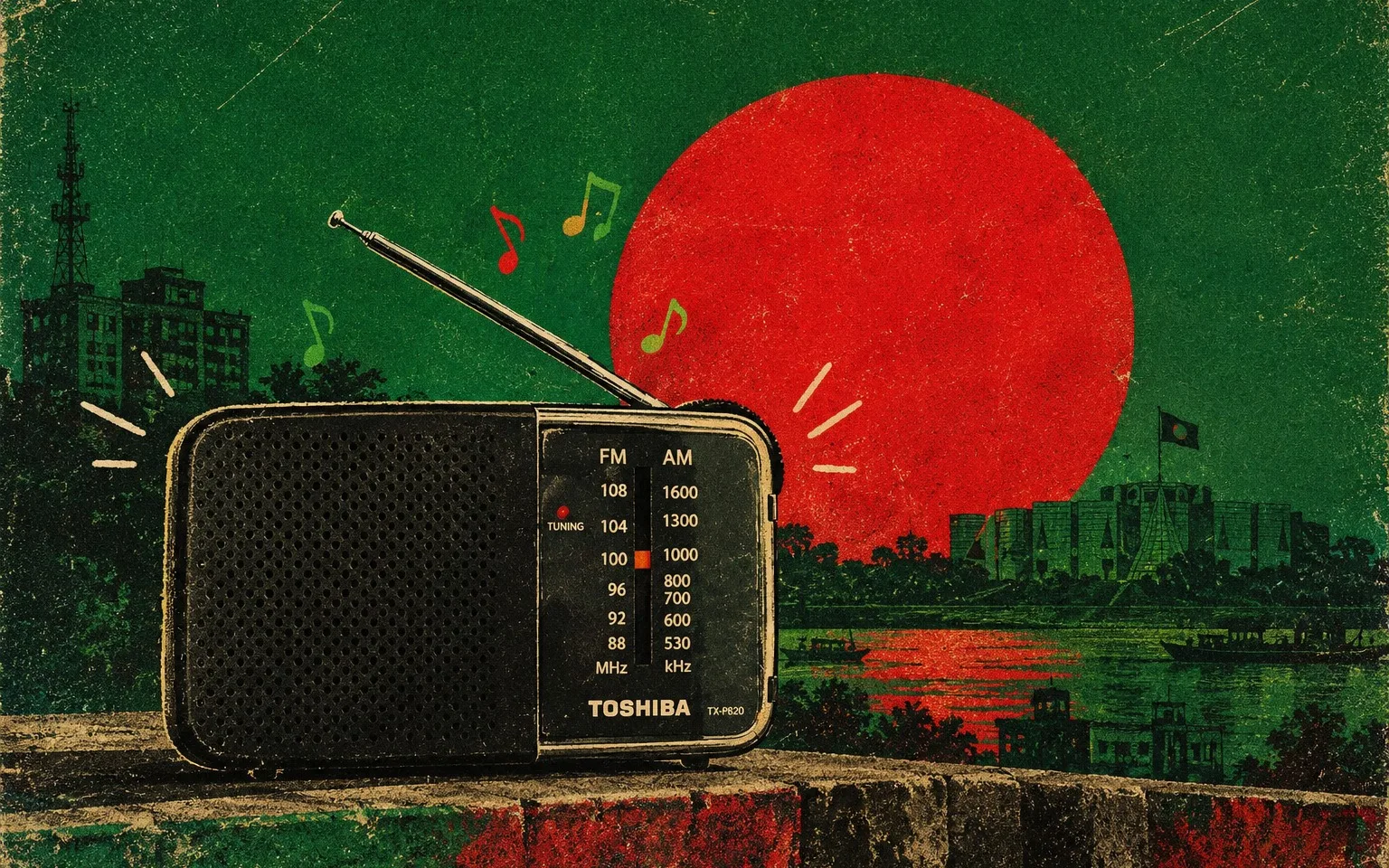
The revolution of FM Radio in Bangladesh can be seen as an uprising of counterculture featuring a raw, unpredictable edge that made it captivating, yet beautifully and positively disruptive in the first place.
At least in South Asian Bangladesh, that has been the case since Independence. Please consider the 2009 dark comedy and cult contemporary film The Boat That Rocked - a colourful crew of DJs aboard a North Sea vessel risk everything to play underground rock and pop for Britain, turning their pirate radio station into a floating symbol of defiance against a conservative government. It was definitely not that aggressive in our country, but hopefully the readers will get the gist.
Although the journey of FM radio stations commenced with Bangladesh Betar Traffic Broadcast in 2005, the very first private FM station, Radio Today started transmission in 2006. They were bold, honest, and unconventional in telling the truth. It was however, Radio Foorti on an August 2006, that started to rock the shores of Dhaka with its casual and carefree narration and that became a real cultural shift by not losing all the urban youth mojo, magic and edge of a generation.
Historically, an elected or selected government would definitely want to regulate tones with its style guide. I mean, you can't budget for fun or control the vibe of a generation; if it’s in moderation – in a country where corruption is holding us by the neck- it’s the beatosphere of a cohort and the ability to have fun responsibly, which acts as respite from the metaphorical negativities. Foorti succeeded, and soon other FM stations followed with their chaotic, expressive, and unscripted programs playing earworms, pop-culture melodies, or viral feuds.
The Paradox of State-Sanctioned Rebelliousness
The power of private FM stations started making sense as it attempted to capture the energy of youth to project an image of progress and tolerance. It became performance art rather than a systemic threat. Listeners started enjoying supermarket pop, trendy hip-hop, defiant rap, rock and other pop culture storytelling at the same time.
You had the traditional music shows with trending music and chart toppers during most of the daytime, but as the night shone and Dhaka’s evil spirits were on the loose, we’d get flamboyant and arousing storylines and story nights where murder, mystery, adultery, gossip, late-night confessions, up to supernatural fictions and realities jazzed up the airwaves with crisp productions and undistorted sound effects – we soon started to see society through bubbles of happiness and anxiety from programs like Hello Dhaka and Bhoutist.
“Being in a band meant I was always tuned in to Radio Foorti or Radio ABC. They played a lot of band music and were constant companions during my commutes. More importantly, these FM stations opened the door to many innovative programs, some of which would eventually have a profound impact on my life" says Shakib Chowdhury, frontman of the band Cryptic Fate. "Of course, I’m talking about Bhoot FM. Through Bhoot FM, horror lovers across Bangladesh suddenly discovered that they were not alone. That they weren’t just a small, isolated community. Their particular brand of weirdness was shared and celebrated by countless people across the country" he adds. "It was through Bhoot FM, hosted by RJ Russell, that people first came to know about Bhoutist, our paranormal investigation team. Sharing our adventures over the airwaves somehow made them permanent. And I can still feel the effects of that, all these years later, as I work on our horror-thriller film, Andhar. The golden age of FM radio didn’t last very long. I wish it had. But it certainly left a lasting impact, at least on my life. ”
"Through Bhoot FM, horror lovers across Bangladesh suddenly discovered that they were not alone. That they weren’t just a small, isolated community. Their particular brand of weirdness was shared and celebrated by countless people across the country."
Managing the "Beatosphere"
The resurgence of FM radio between 2006 and 2013 radically altered Bangladesh's media landscape, drifting from TV, print, and online media and successfully revitalizing a declining format into a dominant cultural force. It did as the private organizations controlled the cultural rhythm, discourse, and narrative of our generation by allowing authorities to channel nonconformist energy safely into our minds and Bengali psyche.
For example, we’d see consumer trends, cheeky advertisements, or heavily managed public celebrations beyond familiarity. Eid, Boishakh, New Year’s, Valentine’s, Mother’s, Father’s, up to cats and dogs’ Days transformed into high-energy festivals. Suddenly the immortal refrain "Melay Jaire" started making more sense.
And the most urgent part was played by the extremely fun and energetic radio jockeys (RJs). Rising from the prehistoric, formal speaking tones, these social celebrities with their wit, sarcasm, husky, raspy, mezzo-soprano voices or high-tenor pitches, featuring often Banglish accents, addressed the listeners informally as tumi with their uber-cool friendly voices. This made us, listeners, enticed to the programs. Celebrity crushes no longer were meant for film and music stars only.
"From my experience, I quickly became a household name for young girls and boys who listened to me while practicing maths or simply when they were lonely, dreaming of becoming an RJ themselves. They found a friend in me, or rather, in all of us. For people who drove around, FM playing their favourite songs became a top choice. It felt like we all had an instant connection"
Sarzina Islam, a popular personality from the heydays of Radio Foorti, reminisces about the good old days. "Back in the days, people had less access to smartphones and the internet. But they all had button phones. Those were our sweet weapons, with FM radios." Expanding on the parasocial relationships that formed because of the medium, she adds "From my experience, I quickly became a household name for young girls and boys who listened to me while practicing maths or simply when they were lonely, dreaming of becoming an RJ themselves. They found a friend in me, or rather, in all of us. For people who drove around, FM playing their favourite songs became a top choice. It felt like we all had an instant connection, and they did not hesitate to spend Tk 1.5 to 2 on us to take part in our conversations via SMS, putting out their opinions and making a point on our shows. Even today, I bump into many of them, who say they are all grown up and have their own lives, but that connection they made during their school days or daily commutes is still something they miss and would want to revisit. But unfortunately, the industry could not flourish, and we are now more a part of that famous "Video killed the radio star" clan."

Interactive Mediums
With the advent of social media, it uniquely blended with FM radio and revamped how young people connected and interacted with each other. Listeners called or texted radio shows to ask for songs, send messages to crushes, or share their thoughts on popular topics. FM stations brought together youth from different backgrounds, making them feel like part of a bigger and shared community, a digital convention of sorts when they opened custom groups on Facebook or YouTube.
The built-in radios in smartphones and our crazy traffic also played a significant part in catapulting FM growth. Millions of commuters soon spent hours being comforted, instead of getting agitated while stuck in painful traffic. It was the perfect escape from boredom, mundane, and frustrating thoughts.
The Economics of Perspective
FM radio acted as a massive loudspeaker for the Bangladeshi music scene, especially a lot of music from the indie genre and our underground scene was heavily promoted. A lot of fresh musical content, PG rated meant for mature audiences, which couldn’t get played in mainstream media like TV, got airtime.
Consequentially, even though, many record label owners want to disregard this, the fact that FM radio did play a significant part for artistes enjoying more sales of music and called for live performances.

“In my humble opinion, FM stations did revolutionise the listening capacity of urban youth when streaming platform itself was not a common thing in Bangladesh" says Ashrafuzzaman Yousufi, the frontman for Arbovirus. "These FM stations dedicated relentless effort in curating their collection of music files in the .WAV format for the best audio fidelity, and thoughtfully crafted their playlist for a wide gamut of listeners, round the clock. It exposed listeners to new artists, genres of music as a whole. This boosted Bangla pop and underground music and the cultural significance was massive during its golden era" he adds. In my observation, the telco sponsors played a significant role in further spiralling down the playlist towards a niche audience they perceived as relevant. This created an alternative timeline in the FM universe! Some stations bent to the telco power amending their playlist, while others kept on broadcasting their original playlist contents during off-peak, non-sponsored hours. Sadly, after the golden rush, FM stations lost its relevance to the mass people as the mass moved towards a newer format (streaming) with more control in their hand to push the next button and play their favourite songs, anytime. I would strongly claim, streaming and telco dominance killed FM stations.”
"In my observation, the telco sponsors played a significant role in further spiralling down the playlist towards a niche audience they perceived as relevant."
What Transpired?
Between 2006 and 2013, FM radio enjoyed its heyday, and eventually free streaming giants like YouTube diversified and took a lot of the spotlight that FM radio was enjoying. Nevertheless, the uprising of FM left a lasting legacy. The spirit of FM radio lived on through the introduction of Community Radio stations in mid-2012, especially in rural areas.
These stations aired vital and critical information on farming, health, and natural disasters for local communities. The 90s powerful Feedback song and Maqsoodul Huq’s immortal refrain: Majhi tor radio nai boila janteo parlina aitase bhainga, eto boro dheu shara Bangladesh janlo majhi, tui toh janlina re. This was not the case anymore.
Faizul Khan Tanim is an Emergency Services Response Officer based in New South Wales, Australia, and a former music journalist.