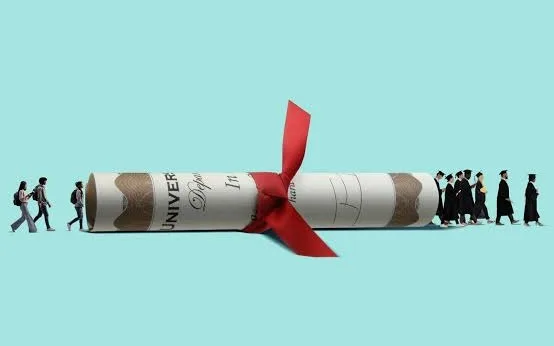
A country opens more universities. More young people earn degrees. Families expect those degrees to lead to secure jobs and better lives.
Then the graduates enter the labour market and find too few suitable jobs, low pay and fierce competition for a small number of government posts.
This is a graduate glut . It happens when the number of graduates grows faster than the number of jobs that can use their qualifications. The IMF says this problem is becoming more visible across Asia, where young people with advanced education often face unusually high unemployment.
On its own, a graduate glut does not cause an uprising. But it is a good predictor of where one may emerge. The same sequence appeared before uprisings in Tunisia, Egypt and Bangladesh: education expanded, jobs failed to keep up, young people lost faith in fair recruitment, and a specific event turned years of frustration into protest.
The broken promise
Graduate unemployment carries a special kind of disappointment.
A family spends years paying tuition, rent and examination fees. The student studies, graduates and expects to move into a secure adult life. Instead, the degree is followed by more applications, more exams and more waiting.
Some graduates remain unemployed. Others accept jobs that do not require their qualifications. Many keep applying for government work because it offers security, status and a clearer career path than most private employment.
The problem is not only financial. Education creates expectations. When those expectations repeatedly fail, graduates start asking whether the system works at all.
That question becomes more serious when recruitment looks unfair. If jobs appear to go to people with political ties, family influence or privileged status, unemployment no longer feels like bad luck. It feels like proof that merit does not matter.
A private disappointment then becomes a public grievance.
Why graduates matter
Graduates are not only unhappy job-seekers. They are also unusually easy to organize.
Universities bring large numbers of young people together. Students build networks through classes, residential halls, coaching centres, political groups and social media. Graduates carry many of those connections with them after leaving campus.
These networks allow information to move quickly. One campus calls a protest. Others join. Videos circulate. Demands are drafted. Lawyers challenge government decisions. Journalists find people ready to explain the issue.
A cross-national study found that larger student populations are linked to more nonviolent demonstrations. Universities help people cooperate and reduce the cost of organizing protests.
The degree may not provide a job. It often provides a network.
The wider evidence
Other research adds an important caution. Surveys from the Middle East and North Africa found that an unemployed person was not automatically more likely than an employed person to join a protest. Political interest and the ability to organize also mattered.
These findings do not cancel each other out. Most unemployed graduates will never join an uprising. But a country with a large, disappointed and well-connected graduate population has more people who can organize when a triggering event arrives.
The graduate glut does not predict the exact date of unrest. It points to where the pressure is growing.
The usual sequence
1. Higher education expands.
2. Suitable employment fails to keep up.
3. Competition for secure jobs becomes severe.
4. Recruitment appears unfair or politically controlled.
5. Students and graduates organize through existing networks.
6. One event gives their anger a clear target.
7. The government responds with force rather than a solution.
8. A protest over one issue grows into a revolt against the wider system.
The trigger varies. It can be a quota decision, a death, a sudden price rise or an act of police violence.
The trigger matters because the anger already exists. It gives thousands of separate disappointments one name and one target.
Bangladesh: the clearest case
Bangladesh in 2024 followed this sequence closely.
The protests began over quotas in government recruitment. Government jobs were highly attractive because they offered security, status and steady income while the wider economy was not creating enough good professional jobs. In one civil-service recruitment round, roughly 346,000 candidates reportedly competed for 3,300 positions.
The quota issue turned a broad jobs problem into a simple question: if good jobs are scarce, why should access to them appear unfair?
That question reached beyond students directly affected by the quota rules. It spoke to graduates who had spent years preparing for public examinations. It also spoke to families that had paid for degrees but could not see the promised return.
Campus networks allowed the protests to spread. The government’s response then changed the nature of the movement. The UN found that initially peaceful student protests were met with serious and systematic repression, helping turn the quota dispute into a wider national crisis.
What began as a protest over recruitment became a fight over justice, violence and political power.
The underlying jobs problem remained. Bangladesh’s final Labour Force Survey for 2024 reportedly counted about 885,000 unemployed graduates. The graduate unemployment rate was 13.5%, the highest among the country’s education groups.
Bangladesh shows the link clearly:
Too few good jobs created the frustration. The quota system made the problem look unfair. Student networks organized the response. Repression widened it into an uprising.
Tunisia: degrees without opportunity
Tunisia faced a similar problem before the 2010–11 revolution.
Higher education had expanded, but the economy did not create enough suitable jobs. Educated unemployment became so common that unemployed graduates formed associations to demand work and fair treatment.
The immediate spark was the self-immolation of Mohamed Bouazizi after harassment by local officials. His death became a symbol of humiliation, corruption and the daily mistreatment of ordinary people. The protests spread across the country and forced President Zine El Abidine Ben Ali from power.
Bouazizi was a street vendor, not a university graduate. So it would be wrong to say graduate unemployment alone caused the revolution.
But the revolt spread through a country where educated young people already felt shut out. They had qualifications but little chance of securing the lives those qualifications were supposed to provide. Graduate groups had also built networks through years of protest and activism.
Bouazizi’s death supplied the spark. The graduate glut helped supply the people ready to carry the protest beyond one town.
Egypt: education meets a closed door
Egypt had once absorbed many graduates into government employment. Over time, that route narrowed sharply.
Among educated people entering the labour market, the share moving into public employment reportedly fell from about 70% in 1980 to around 20% by 2006. The formal private sector did not create enough secure jobs to replace those lost opportunities.
Many graduates remained unemployed, waited for government positions or accepted insecure work below their expectations. Research on Egypt’s labour market identifies the frustration of educated but jobless young people as one factor behind the 2011 revolution.
The revolution also grew from police brutality, corruption, political repression and demands for dignity and freedom. The jobs crisis did not replace these causes. It helped connect them.
A graduate who cannot find work may blame the economy. A graduate who also sees corruption, police abuse and no peaceful route to change may blame the political system.
Egypt had educated a generation without providing enough jobs or political voice. That generation became an important part of the movement that filled Tahrir Square.
Sudan: graduates as organizers
Young people formed the backbone of the protests. They organized through neighbourhood committees, volunteer groups and social media. Many of these networks had developed through earlier campaigns and years of resistance.
Sudan is not as direct a graduate-glut case as Bangladesh, Tunisia or Egypt. Food prices, economic collapse and authoritarian rule were the main public grievances.
But educated young people helped turn those grievances into an organized national movement. They did not necessarily supply the first complaint. They supplied much of the organization.
This shows another way a graduate glut can matter. Sometimes graduates lead a protest about jobs. At other times, they organize a much wider public revolt.
Sri Lanka: when everyone joins
Sri Lanka’s 2022 Aragalaya followed a severe economic crisis. Fuel shortages, power cuts, inflation and a shortage of essential goods brought people from many parts of society into the streets. The movement eventually forced President Gotabaya Rajapaksa from office.
Students, professionals and educated young people played visible roles in organizing protests and shaping demands for wider political change.
Sri Lanka was not mainly an uprising of unemployed graduates. The economic collapse affected nearly everyone.
The case still adds to the pattern. Educated youth helped give structure and language to public anger. Once their concerns about blocked futures joined a national crisis over food, fuel and government failure, the movement gained a much larger base.
How closely do the cases fit?
| COUNTRY | ROLE OF GRADUATE GLUT | TRIGGER | STRENGTH OF LINK |
| Bangladesh, 2024 | Scarce graduate jobs and access to government employment were central to the first protests. | Quota dispute and state repression. | Very strong |
| Tunisia, 2010–11 | Unemployed graduates had already organized around jobs and exclusion. | Bouazizi’s death and the government’s response. | Strong |
| Egypt, 2011 | Educated youth faced shrinking public employment and poor private alternatives. | Police abuse, corruption and authoritarian rule. | Strong supporting role |
| Sudan, 2018–19 | Educated young people helped organize a broader movement. | Bread prices and economic crisis. | Stronger as an organizing force |
| Sri Lanka, 2022 | Students and professionals helped lead a broad public movement. | Economic collapse and shortages. | Supporting role |
Supporting role Bangladesh, Tunisia and Egypt provide the clearest evidence. In all three, educated unemployment and blocked opportunity were public grievances before the uprisings.
Sudan and Sri Lanka show a related pattern. The main complaint was broader economic failure, but educated young people helped organize the movement and explain its demands.
Why doesn’t every glut cause revolt?
Graduate unemployment is a predictor, not a guarantee.
Some graduates migrate. Some eventually find work. Some rely on family support.
Others vote against the government or withdraw from politics.
Institutions also matter. Trusted courts, fair elections and open recruitment systems give people peaceful ways to challenge bad decisions. A growing private sector can offer alternatives to government employment.
Organization makes a difference too. Morocco, Tunisia and Egypt all had serious educated-unemployment problems, but unemployed-graduate groups developed differently in each country. Similar grievances did not produce identical movements.
Anger can remain private for years. It becomes politically dangerous when people discover that thousands of others share it and that existing institutions will not fix it.
The warning signs
- Graduate unemployment remains high for years.
- More graduates work below their qualifications.
- Applications for government jobs greatly outnumber vacancies.
- Recruitment examinations lose public trust.
- Students believe political connections matter more than merit.
- Protests spread from one campus to another.
- Employment demands begin using the language of justice and dignity.
- Workers and professional groups join student protests.
- The government responds to a limited demand with arrests or violence.
- Protesters stop asking for one rule to change and start asking for the government to leave.
The sequence matters.
A crowded recruitment examination is an employment problem. A recruitment system widely seen as unfair is a political problem. A violent crackdown on people challenging that system can become a national crisis.
What the evidence says
The clues lead to a clear finding.
A graduate glut is a good predictor of where an uprising may emerge because the same path has appeared in several countries. Education expanded. Suitable jobs did not. Graduates began to doubt that effort and merit would bring opportunity.
Universities and digital networks helped them organize. A specific event then turned years of frustration into collective action.
That path was visible in Tunisia before 2010, Egypt before 2011 and Bangladesh before 2024.
The predictor has limits. It cannot give the date of an uprising. It cannot show whether a government will negotiate, use force or survive the crisis. It must also be read alongside corruption, prices, political freedom and the behaviour of security forces.
But a predictor does not need to name the day.
It needs to identify where the risk is growing before the crisis begins. Graduate unemployment does that well because it points to a large group with disappointed expectations, strong networks and a reason to question whether the system is fair.
The final clue is how graduates explain their own situation.
As long as unemployment feels like personal bad luck, the problem may remain private. When thousands begin to see it as proof that the system is unfair, it becomes political.
That change appeared before uprisings elsewhere. Bangladesh followed the same path.