India Denies Government Role in Hasina’s Scheduled Media Address
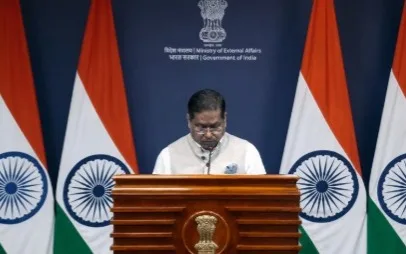
Jaiswal’s remarks follow reports that ousted Prime Minister Sheikh Hasina is scheduled to deliver a virtual address to the Foreign Correspondents' Club of South Asia in New Delhi tomorrow.
Reading
In a Nutshell:
- Sheikh Hasina was scheduled to virtually address the Foreign Correspondents’ Club (FCC) of South Asia in New Delhi on August 5, marking her first public appearance since fleeing to India in August 2024.
- MEA spokesperson Randhir Jaiswal said the event is organised by a “private media entity,” with the Indian government having “no involvement whatsoever” and not endorsing any views expressed.
- India made a nearly identical denial in February 2025 after summoning Bangladesh’s envoy over earlier Hasina remarks.
- Bangladesh’s foreign affairs adviser Humaiun Kobir said on August 3 that the event “could undermine the positive momentum” in Bangladesh-India relations.
- Dhaka formally conveyed this concern to Indian High Commissioner Dinesh Trivedi on August 3, and State Minister Shama Obaed Islam publicly demanded India clarify its position.
- Jaiswal declined to comment when asked whether Hasina’s potential return to Bangladesh came up in a separate meeting between US Special Envoy Sergio Gor and Trivedi.
Why it matters
India hosting (even passively) Hasina’s re-entry into public discourse tests the “positive momentum” both governments have claimed to be building since the political transition. The recurring “private event, no government role” defense (used again after a similar February 2025 episode) signals India is trying to avoid diplomatic accountability while still allowing Hasina a public platform from its soil.Any Hasina public appearance is politically explosive in Bangladesh, where her fall triggered the 2024 uprising; even a virtual address risks reactivating domestic political tensions ahead of Bangladesh’s 2026 referendum-related transition.The unanswered question about Gor-Trivedi discussing Hasina’s “return” suggests the US may be quietly involved in extradition or asylum-status conversations, adding a third major power into an already sensitive bilateral dispute.
What we think
India’s “no involvement” defense should be treated with skepticism, not accepted at face value — this is the second time in roughly 18 months that New Delhi has used near-identical language to distance itself from Hasina’s public statements while doing nothing to prevent them, suggesting a deliberate pattern of hosting her political activity while dodging accountability. Allowing a former prime minister facing serious charges to broadcast to international media from Indian soil, even “virtually,” is not a neutral act; India has the sovereign capacity to restrict such activity and its choice not to do so functions as tacit protection of Hasina’s political relevance. Dhaka should stop treating India’s clarifications as good-faith diplomacy and instead recognize them as a recurring tactic to avoid formal responsibility while still extracting leverage from Hasina’s continued presence as a bargaining chip in the bilateral relationship. Bangladesh should escalate beyond statements and press briefings toward concrete diplomatic and legal pressure including renewed extradition demands rather than accepting India’s carefully worded denials as sufficient. The murkiness around whether the US and India discussed Hasina’s “return” without informing Dhaka should also be read as a warning sign that Bangladesh’s interests may be sidelined in great-power conversations happening about it, not with it.