Riyadh’s Mecca Pact Talks Begin Today: Where Does Bangladesh Stand?
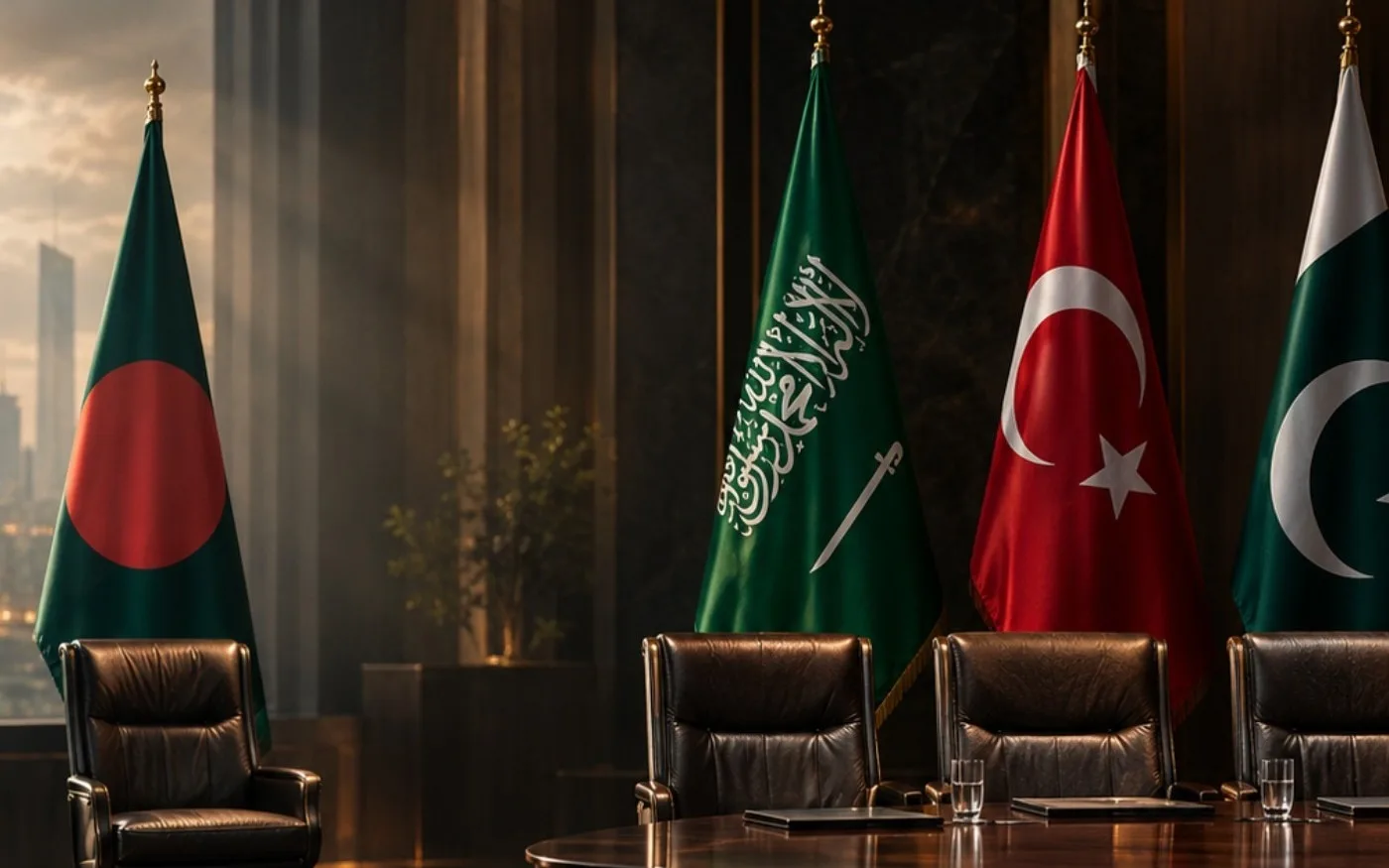
Turkey, Saudi Arabia, and Pakistan’s Strategic Political and Defence Committee, under the Mecca Joint Defence Agreement, is scheduled to meet in Riyadh on 5 October.
Reading
In a Nutshell
- Turkey, Saudi Arabia and Pakistan’s Strategic Political and Defence Committee under the Mecca Joint Defence Agreement is scheduled to meet in Riyadh on 5 October.
- Turkey is sending Foreign Minister Hakan Fidan, Defence Minister Yaşar Güler and Chief of General Staff Gen. Selçuk Bayraktaroğlu.
- The agenda includes recent regional developments and progress in building the alliance’s institutional machinery.
- The talks follow Yemen’s Saudi-backed government announcing a major military operation against Houthi-held territory, adding urgency to regional security deliberations.
- Pakistan has said the committee is also expected to consider Iran’s proposal for political engagement with the Houthis after their attacks.
Context
The Mecca Joint Defence Agreement was signed by Saudi Arabia, Turkey and Pakistan in August 2026 after nearly a year of negotiations, committing the three states to regard an armed attack on one as an attack on all. Its declared purpose is collective deterrence amid worsening Middle East instability, including threats to Saudi territory, Red Sea routes and regional infrastructure linked to the Yemen conflict.
The pact has been presented as defensive rather than directed at a named adversary, and Turkish officials have said it does not supersede the members’ pre-existing agreements with other states. Yet key operational terms remain undisclosed: there is no publicly defined joint command, standing force, automatic trigger, or clear specification of the military obligations that follow when a member is attacked.
Why It Matters
The Riyadh meeting marks a transition from a political declaration to the difficult work of creating a usable security mechanism. The Yemen escalation makes that task immediate: Houthi attacks and instability around the Red Sea place Saudi security, energy infrastructure and one of the world’s most important shipping corridors under pressure. Turkey brings a large, capable military and an expanding defence-industrial base, while Pakistan brings military experience, strategic depth and longstanding security ties with Saudi Arabia; together, the pact signals that Riyadh is diversifying its security partnerships beyond its historic dependence on the United States. However, collective-defence language raises the prospect of entanglement. If the alliance interprets attacks by non-state groups as triggers for mutual action, a confrontation in Yemen could test the boundaries of commitments that remain deliberately vague.
What We Think
Dhaka is keeping an eye on the proposed Mecca pact, but it’s in no rush to jump in. While Bangladesh has shown mild curiosity, it hasn't actually received a formal invite or membership pitch from the founding trio, Saudi Arabia, Turkey, and Pakistan.
Foreign Minister Khalilur Rahman made Dhaka’s stance clear enough: the government will only seriously entertain the idea if the existing members formally lay out the welcome mat.
Rushing to sign on offers little tangible upside while carrying plenty of strategic headaches. On paper, the pact’s talk of collective defence sounds vaguely like a regional NATO, yet crucial details, such as who commands what, how it’s funded, and what actually triggers military action, are completely up in the air.
Signing up could easily drag Bangladesh into foreign entanglements it has no business fighting, whether that’s the fallout from Gulf-Iran rivalries, the war in Yemen, or flare-ups in the Red Sea. It would also throw a wrench into Dhaka’s carefully calibrated balancing act with key partners like India, China, Iran, and the United States, as well as the pact’s own members. Plus, with Turkey anchored in NATO and the Gulf still tied closely to Washington’s security umbrella, joining wouldn’t mean stepping into an entirely independent bloc anyway.