Four Journalists Injured in Chhatra Dal Attack at Rajshahi University
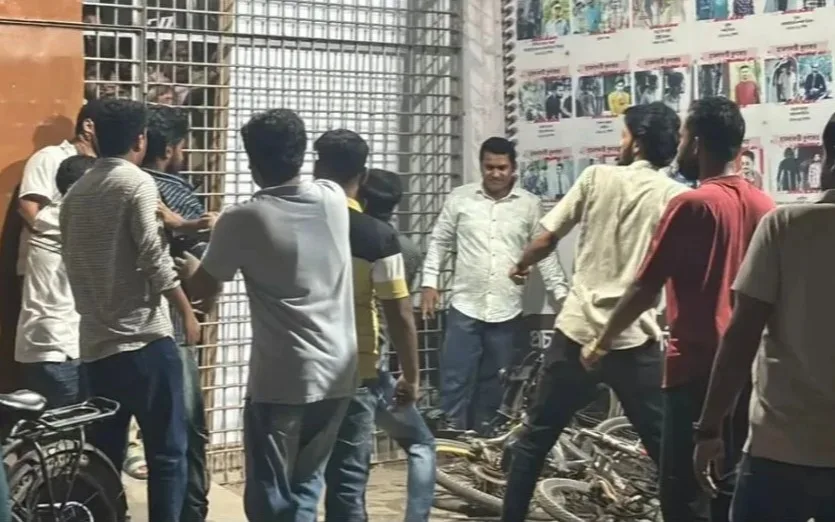
At least 10 people, including four journalists, were injured after Jatiyatabadi Chhatra Dal leaders and activists allegedly attacked students and journalists with locally made weapons at Rajshahi University on Sunday night. The incident followed a dispute involving Chhatra Dal and RUCSU leaders.
Reading
In a Nutshell
- The attack took place around 8:30pm near Shaheed Ziaur Rahman Hall after Chhatra Dal activists arrived in a procession from Transport Market Area to look for General Secretary Ariful Islam.
- Witnesses said they were carrying machetes, cleavers, hockey sticks, pipes and baseball bats which they hid from Proctor Prof Mahbubur Rahman.
- When journalists tried to record the weapons, they were allegedly beaten and threatened, while an attempt was made to snatch the phone of Ajker Patrika correspondent Din Islam.
- Four journalists were injured: The Daily Star’s Nur Ahsan Mridul, Agamir Shomoy’s Zihadul Islam, bdnews24.com’s Arifuzzaman Qurban and Samakal’s Mainul Islam Raju.
- At least 10 leaders from Chatra Dal were involved in the incident including RU Chhatra Dal vice-presidents Ahsan Habib and Shariful Islam, Joint General Secretary Hasibul Islam and Assistant Office Secretary Shahriar Alam
- Chatral Dal leadership issued statements, claiming ignorance of the incident and that they were looking into it to find the culprits.
- RU Chhatra Dal President Sultan Ahmed Rahi said, “I have informed the central Chhatra Dal. Action will be taken against them quickly.”
- Chhatra Dal Central General Secretary Nasir Uddin Nasir said, “I have just learnt about the incident. I am trying to get the details. We will take action against those responsible.”
- University authorities have also promised action while admitting they were unable to contain the situation.
- RU Pro-VC Prof Abdul Alim said, “We will take necessary action after an investigation. We will not tolerate any criminal activities on campus. Those involved will be brought under the law.”
- RU Proctor Mahbubur Rahman said, “We failed. We could not control the situation. We called the police, but the police fled in fear.”
- Separately, the National Citizen Party (NCP) condemned the attack and demanded the arrest and punishment of those responsible.
Context
The incident followed a dispute involving Chhatra Dal leader M Ahsan Habib and RUCSU Assistant Cultural Secretary Rakibul Islam over comments on a Facebook post concerning RUCSU General Secretary Salahuddin Ammar. Habib alleged that Rakibul had used abusive language about his mother and sister. Rakibul said Habib had threatened to assault him and asked for his location.
The dispute became more serious on Saturday, when both Rakibul and Habib came to campus for a confrontation. Rakibul stayed outside Shaheed Ziaur Rahman Hall from 10am to 5pm. Habib later arrived with several Chhatra Dal leaders and activists, some carrying baseball bats, and said they would remain there until 10pm.
On Sunday, Hall Union General Secretary Ariful Islam later accused Chhatra Dal members of carrying locally made weapons and engaging in violence in a Facebook post. Witnesses said Chhatra Dal activists then arrived at the hall around 8pm, looking for Ariful with several carrying weapons. Journalists began recording the group, after which the attacks followed.
Why It Matters
When journalists themselves get caught in the crossfire while reporting on campus violence, it shows how violent and uncontrolled these incidents have become. And Rajshahi University is far from being an isolated case. At Dhaka University in April 2026, six journalists were harassed and threatened while covering tensions between Chhatra Dal and Chhatra Shibir.
The same pattern has appeared elsewhere too. In 2023, two student journalists at Rajshahi College were attacked after photographing political activists vandalising the campus. Today’s incident is just one of many cases where violence between student political groups has reached the journalists covering it.
What We Think
Thus, the pattern is familiar: someone does not see eye to eye with a member of another political group, a student clash follows, journalists covering it get attacked, and university authorities assure everyone that action will be taken.
The problem is that the university body rarely follows up these words with action to hold the culprits accountable. This inevitably ensures that the cycle of campus violence will repeat.