Tarique Sets Four Priorities for Bangladesh’s Maritime Sector
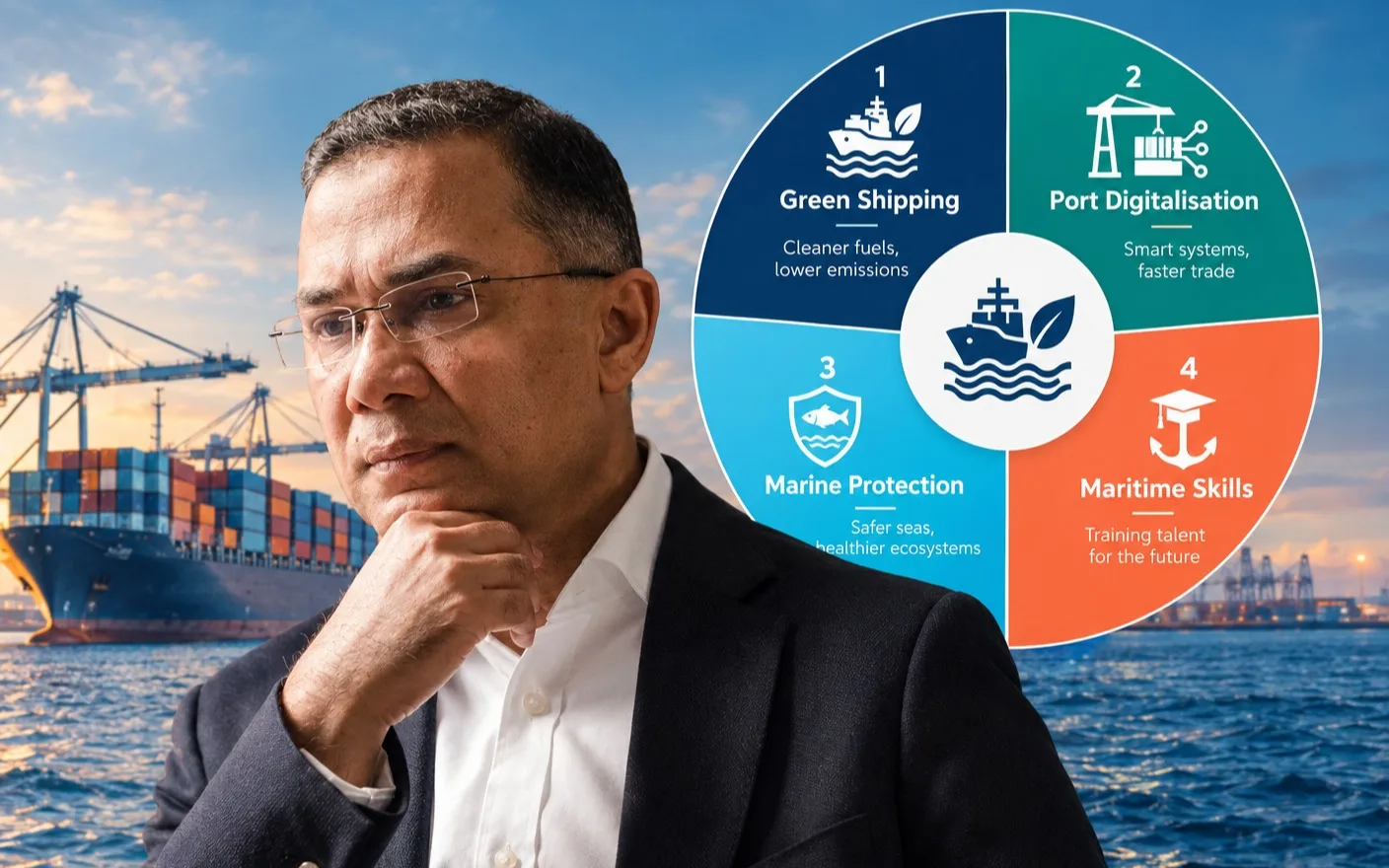
Prime Minister Tarique Rahman has called for stronger implementation of maritime policy as Bangladesh seeks to expand its blue economy and strengthen its position in regional and global shipping. He outlined four priorities for 2026 covering green shipping, port digitalisation, marine protection and maritime skills.
Reading
In a Nutshell:
- Tarique said Bangladesh will pursue sustainable use of marine resources through deep sea fishing, eco tourism and coastal industries, with a proposed National Blue Economy Authority.
- The government will prioritise decarbonising domestic and ocean-going shipping and developing world-class ship recycling facilities.
- Its 2026 priorities include automated and digital port logistics, expanded hydrography and action against marine plastic pollution, and upgraded maritime training institutes.
- More than 90% of Bangladesh’s international trade is seaborne through Chattogram, Mongla and Payra ports and the country’s river network.
Context
Bangladesh has built a legal and institutional framework for maritime boundaries, shipping, and ports, and has joined 29 International Maritime Organisation conventions, while developing maritime spatial planning for fisheries, tourism, conservation, and other marine uses. The blue economy now extends to marine fisheries and mariculture, ports and shipping, offshore energy, coastal tourism and marine biodiversity. Bangladesh has around 31 green-certified ship recycling yards and plans to increase this number to over 100. The BNP pledged during the February election campaign to establish a specialised blue economy university in Cox's Bazar. The proposal has since entered government planning as the University of Blue Economy Sciences and Technology, which will use existing facilities at the Bangladesh Oceanographic Research Institute for research and training in marine and coastal fields.
Why it matters
The economic case for the four priorities lies in reducing Bangladesh’s dependence on foreign maritime capacity while developing new sources of income from its waters. Foreign-flagged vessels carried 89% of Chattogram’s import cargo and 84% of its export cargo in the first half of 2026, so expanding Bangladesh’s own shipping capacity could retain more freight spending domestically. Automated ports can improve the flow of that trade, while ship recycling, offshore activities, fisheries, and coastal tourism create opportunities beyond cargo handling.
What we think
The policy is coherent because the four priorities address different constraints within the same maritime economy, from moving goods and managing vessels to developing marine resources and supplying skilled workers. Its feasibility is less certain at the institutional level: Bangladesh has the legal framework and several established industries, but officials have acknowledged coordination problems among maritime institutions. The value of the agenda will therefore depend on whether these areas are developed together rather than through separate projects that leave gaps between them.