
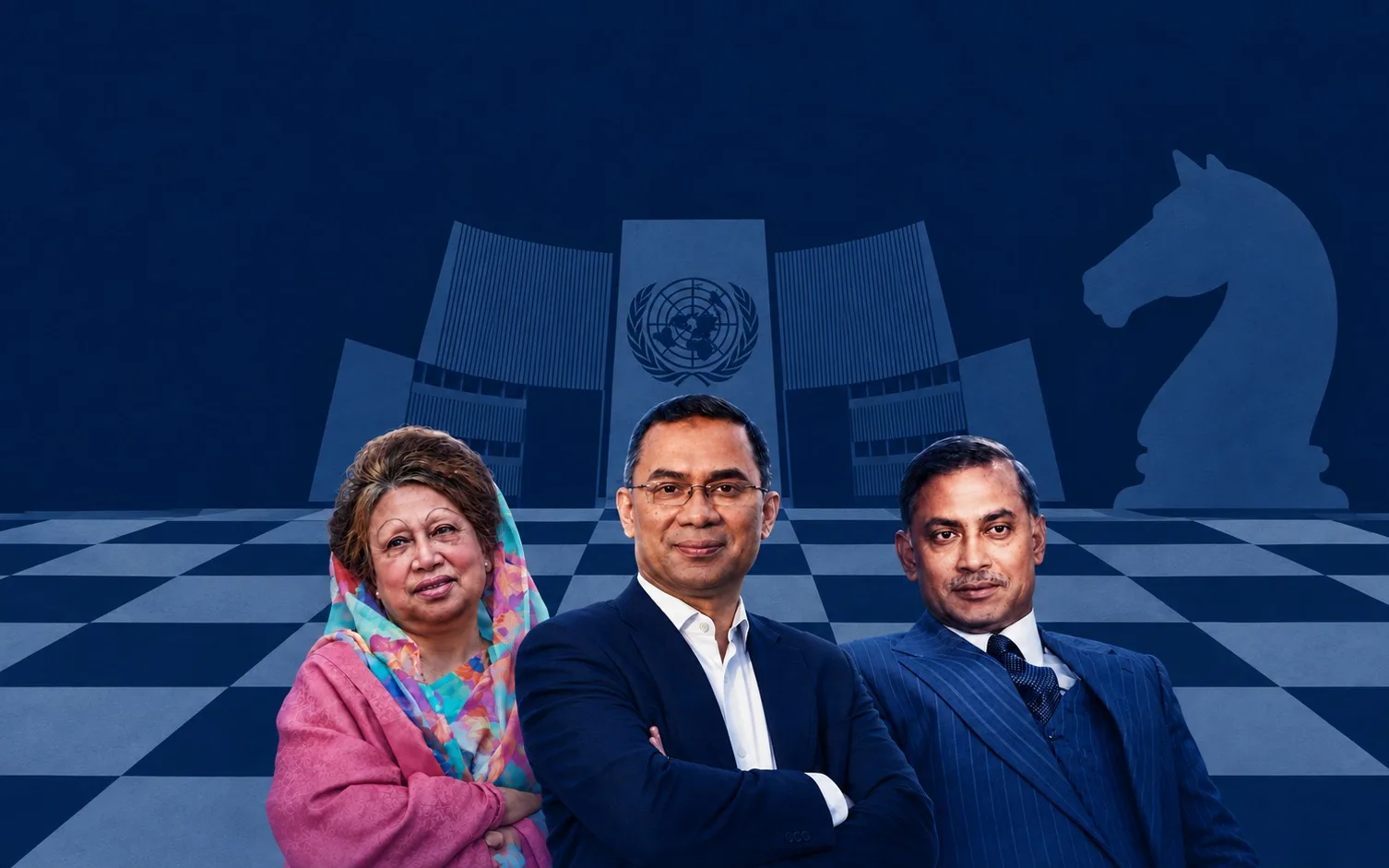
Tarique Rahman landed at Shahjalal this morning at 8:21 AM, and if you squinted at the tarmac footage, you could almost see the ghost of his father disembarking somewhere in the grain of it. Three generations of one family have now stood at that podium in Turtle Bay, which is either a remarkable continuity or a slightly uncomfortable reminder that Bangladeshi politics keeps returning to the same address. Ziaur Rahman spoke there. Khaleda Zia spoke there. And now the son, twenty one minutes in Bangla, at four in the morning our time, while most of Dhaka slept through what its Prime Minister was calling a "3 R" strategy for the country's soul.
Recovery, restoration, reconstruction. It has the cadence of a slogan built by committee, and it probably was. But underneath the acronym is something worth taking seriously, a government trying to describe itself into legitimacy on a stage where legitimacy is the only currency that matters.
Recovery, restoration, reconstruction. It has the cadence of a slogan built by committee, and it probably was. But underneath the acronym is something worth taking seriously, a government trying to describe itself into legitimacy on a stage where legitimacy is the only currency that matters.
When Rahman's motorcade rolled out of JFK, BNP leaders and activists lined the roads with banners and festoons, chanting "Tarique Rahman is coming, the streets are shaking," while the man himself waved back through the window like this was a homecoming rather than a diplomatic errand. It's a nice image. It's also a slightly odd one.By the time he reached the Hyatt Grand Central, a crowd carrying national flags had gathered right at the entrance, chanting his name into the Manhattan evening, and for a few hours a midtown hotel lobby felt a little bit like Paltan. That's genuinely moving if you love this country, and genuinely uncomfortable if you remember that Paltan is also where things tend to get complicated fast. The same diaspora enthusiasm sat only blocks away from rival Awami League activists staging their own counter processions, a reminder that Bangladeshi politics doesn't stay home even when we travel five thousand miles away from it. Diaspora energy like that doesn't get manufactured, it shows up because people actually wanted to be there, and that's worth respecting. But it also travels with all our old fractures packed neatly into the same suitcase, and New York got a small preview of exactly that this week.
In my experience the UN General Assembly is less world forum and more world theatrics. A completion of punch lines if you will. Leaders don't go there to persuade the world of anything specific. They go to be seen persuading, which is a much older art. Rahman's speech did what a debut speech is supposed to do. It named Gaza, it named Rohingya, it named climate finance and AI equity (basic UNGA buzz words). BNP's local units back home were quick to call it "visionary" and "guideline oriented," which tells you more about the party's own anxiety than the speech's actual quality. A first UN address gets judged less on rhetoric than on whether the room believed you'd still be standing next year. Probably, I think, but nobody's betting the house on it yet.
But the speech was theatre. The real story was the eleven meetings scattered across five days, and each one was doing quiet, specific work rather than performing for cameras.
Erdoğan came first, mostly trade and investment talk, Türkiye positioning itself as an economic partner rather than just a diplomatic friend. Sharif was warmer than the moment probably should have allowed, given Pakistan was simultaneously trading insults with India at the very same Assembly, and Dhaka leaning toward Islamabad right now is not a neutral gesture; it's a signal, and signals in this region travel loudly. Bhutan's Tobgay and the Maldives vice president were smaller, tidier conversations about deepening regional ties that nobody expects headlines from, but matter over a decade. Croatia's Plenković wanted to talk labour mobility and technology, an unusual but sensible partner for a country trying to diversify who it does business with. Haiti's Fils-Aimé was brief, mutual solidarity between two countries that know something about political upheaval. Thailand's Anutin was courtesy and interesting at the same time in my humble opinion, serving as a test to secure a long standing free trade agreement and reaffirming Dhaka’s looking east policy.
Kuwait's Crown Prince, Saudi Arabia's Faisal bin Farhan, and the UAE's deputy leadership were all variations on the same urgent theme, protecting the roughly 81 percent of our migrant workers sitting in Gulf states whose neighbourhood currently includes an active war. Pezeshkian was the one meeting that wasn't remotely ceremonial. Rahman needed Iran's cooperation for safe passage of Bangladeshi ships through Hormuz, because right now that's not a courtesy request, it's a war zone request, and it read that way. Ajay Banga from the World Bank got a longer, warmer conversation about expanding partnership and cushioning Bangladesh against the energy shocks rippling out of that same conflict, and underneath it sat a quieter worry, LDC status. Dhaka has been telling anyone at the UN who'll listen that graduating countries need more time, more macroeconomic stability, more reform runway, before the trade privileges disappear. Asking the World Bank for warmer support while simultaneously asking the UN for a longer runway out of developing status is not a contradiction exactly, but it is a country hedging both bets at once, hoping to look resilient enough to graduate and fragile enough to still get help. Guterres offered mostly gratitude, thanking Bangladesh for hosting Rohingya refugees and contributing peacekeepers, the kind of meeting that reinforces standing without moving any money.
Asking the World Bank for warmer support while simultaneously asking the UN for a longer runway out of developing status is not a contradiction exactly, but it is a country hedging both bets at once, hoping to look resilient enough to graduate and fragile enough to still get help.
And then there's Boeing, which I think is the story everyone's too polite to actually interrogate. Eleven more jets, stacked on an already signed 3.7 billion dollar order, with financing terms and delivery timelines still not made public. Our own editorial pages have started asking the obvious question: why should an elected government inherit commitments negotiated by an interim administration under tariff duress (That’s right, I said it!)? Airbus, for what it's worth, keeps gently reminding everyone that fleet decisions should be made "on merit, not politics." A very European thing to say. Also correct.
I don't begrudge Dhaka wanting American goodwill. Trade leverage is trade leverage, and Trump's tariff threats were real enough. But there's a difference between diplomacy that uses aircraft and aviation strategy that happens to carry diplomatic benefits, and right now we're clearly doing the first while calling it the second.
So now, what happens? What will we watch next? None of that speech is what I'll actually be watching. Speeches are furniture. I'll be watching whether the sixth Iran Bangladesh Joint Economic Commission, promised for over a decade and unconvened since 2013, finally happens, or joins the long list of things we announce and then quietly forget. I'll be watching whether the World Bank's warm words to Banga turn into actual disbursed money for the energy shocks we're currently absorbing, rather than staying "readiness to help," which is diplomatic shorthand for nothing yet. I'll be watching whether the Gulf conversations produce a real skilled labour agreement, because "moving beyond entry level exports" has been said by every foreign ministry statement since roughly 2019, and none of it has moved an inch. Mostly, though, I'll be watching whether any of this reaches the man standing in a fuel queue in Mirpur, watching electricity subsidies evaporate three months into the fiscal year while his Prime Minister talks about reconstruction from a podium six thousand miles away. Because that, in the end, is the only audience that actually matters. The UN forgives almost anything. Dhaka in September going to October, with prices what they are, forgives quite a bit less.