A Trillion-Dollar Pitch from A Country Still Asking For More Time
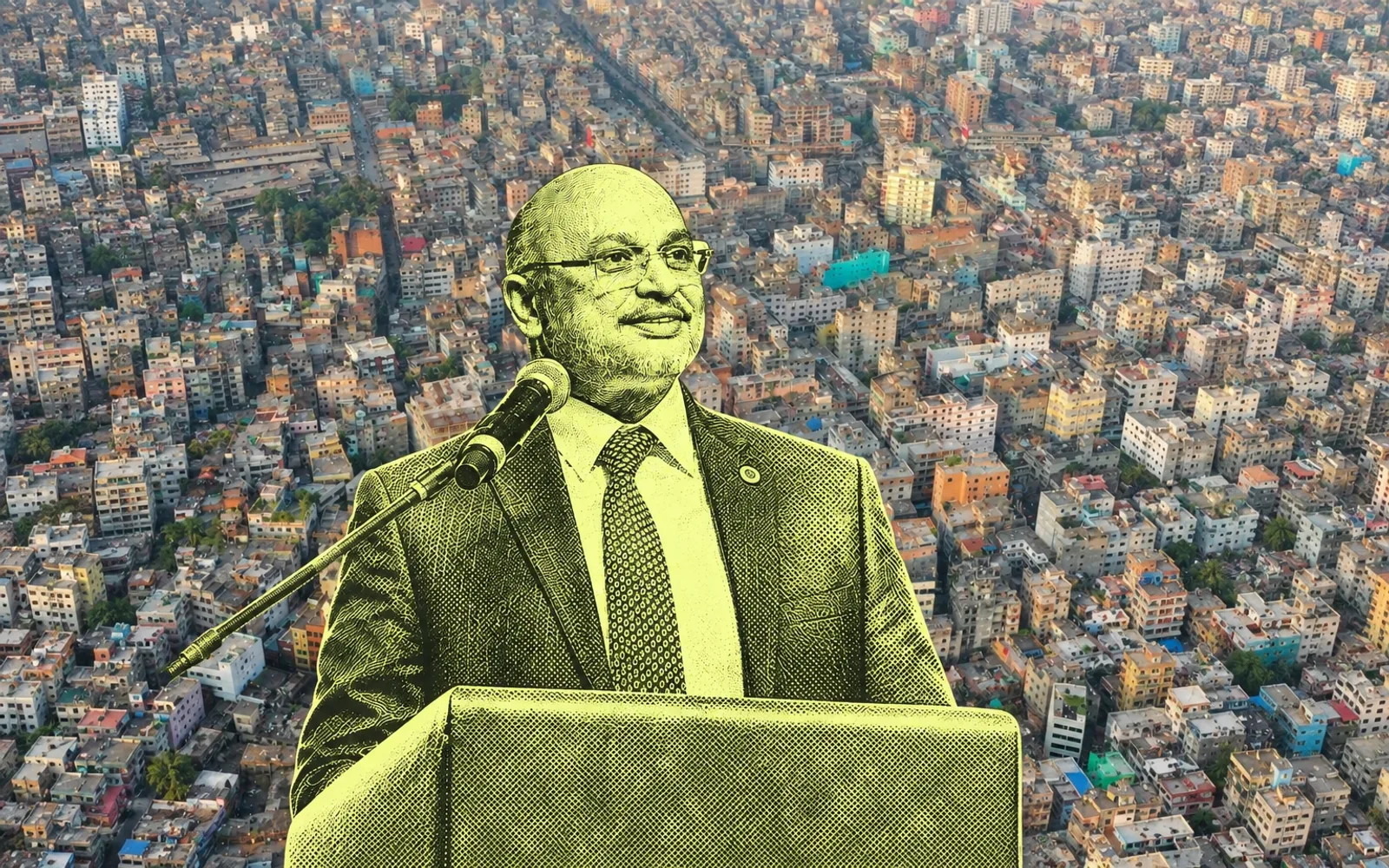
Prime Minister's Finance and Planning Adviser Rashed Al Mahmud Titumir said Bangladesh has begun a transformation journey towards a trillion-dollar economy by 2034, moving beyond the fragile economy inherited from the previous regime.
Reading
In a Nutshell:
- Prime Minister's Finance and Planning Adviser Rashed Al Mahmud Titumir said Bangladesh has begun a transformation journey towards a trillion-dollar economy by 2034, moving beyond the fragile economy inherited from the previous regime.
- He was speaking as the chief guest at the American Association of Bangladeshi Engineers and Architects (AABEA) biennial convention in Detroit on Saturday.
- He described a development model built on recovery, restoration, and reconstruction, focused on investment, production, employment, and increased public investment in education and healthcare.
- He said Bangladesh aims to become a competitive manufacturing hub through industrial diversification, higher productivity and technological advancement.
- He urged Bangladeshi-American professionals to connect Bangladesh with US universities, labs, technology firms and investors, mentor young engineers, support technology transfer and link start-ups to global capital.
- He proposed a sustained platform linking diaspora expertise with Bangladesh's universities, industries and entrepreneurs.
Context
The target is not new. In March, Titumir first set out a roadmap to a trillion-dollar economy by 2034. He repeated it in June at a pre-budget roundtable, where he described the model's ideological base as the democratisation of the economy. According to provisional BBS data, GDP reached about $501 billion in FY26, up from roughly $456 billion the year before, with growth of 4.14%, up from 3.49%. The FY27 budget targets 6.5% growth. In April, the World Bank recorded FY26 inflation at 8.5%. It also found that the national poverty rate rose to 21.4 per cent in 2025 from 18.7 per cent in 2022. Bangladesh is scheduled to leave the LDC category on 24 November 2026, having met all three criteria in consecutive reviews since 2018. After the BNP government took office, the Economic Relations Division asked the UN Committee for Development Policy (CDP) to extend the preparatory period to 24 November 2029. The CDP responded positively, on condition of significant progress on key domestic reforms. ECOSOC has since recommended that the General Assembly decide before 24 November.
Why It Matters
The speech matters less for what it announced than for where it was said. At the UN, Bangladesh's case for staying in the LDC group rests on fragility: its request argued that overlapping crises had disrupted its preparations. In Detroit, the same government's economic adviser described a country on its way to a trillion dollars. Technically, the two stories can coexist. LDC status is judged on per capita income, human assets, and vulnerability, not on the size of the economy, and the CDP found that Bangladesh exceeds all three thresholds by a significant margin. Politically, they pull in opposite directions. A government that tells the UN it is fragile and tells investors it is taking off will be asked which is true, and the answer affects how much patience it gets. The CDP has already said the extension should not be treated as a pause on reform, and that it does not foresee supporting any further extension. There is a domestic parallel, too. The previous AL government turned LDC graduation into a political symbol of success, even as the underlying data were called into question. The trillion-dollar figure risks becoming this government's version: a number that defines it against its predecessor before anyone can test it.
What We Think
Titumir's destination is possible on paper. His route is not. By our calculation, doubling a $501 billion economy by FY2033-34 would require roughly 9 per cent annual growth in dollar terms. Real growth last year was 4.14%. Inflation and a stable taka make up the rest, and that measures prices, not prosperity. The engines he named are running backwards. Total investment fell to 27.93% of GDP in FY26, marking its third straight decline, while private investment slipped to 21.53%. Private credit grew 4.47% against an 8.5% target. Tax revenue fell below 7% of GDP in FY25, too little to fund the education and health spending he promised. And banks carrying 30.6% bad loans are in no position to fund an investment boom. The remedy is three steps. Publish the growth, inflation and exchange-rate assumptions behind the target, or swap the dollar headline for real measures: investment, formal jobs, tax collection and export diversification. Take the reform plan promised to the UN abroad as the economic story. Give the diaspora platform an owner, a budget and a deadline. Otherwise, it stays a line in a speech.